
A walking stick is the simplest piece of hiking gear there is, and one of the most useful. This guide covers how to choose one, how to set it to your height and how to use it on different ground.
One stick or two poles?
- A single walking stick gives balance and support at walking pace and leaves one hand free. It suits day walks, hunting, uneven farm or forest ground and anyone who wants a steadier step.
- A pair of trekking poles is planted with every stride and spreads effort across both arms. Poles suit long distances with a heavy pack, at the cost of having both hands busy.
What to look for
- Material. Steel is the heaviest and the hardest to damage. Aluminium is lighter and still strong. Carbon fibre is the lightest but can crack under a sideways knock.
- Grip. A textured, anti-slip grip matters most when your hands are wet or cold.
- Length. A stick that adjusts, or comes apart into sections, is easier to fit to your height and to carry in a car or on a pack.
- Tip. A hard tip bites on soil and rock. On pavement or indoors a rubber cap is quieter and kinder to floors.
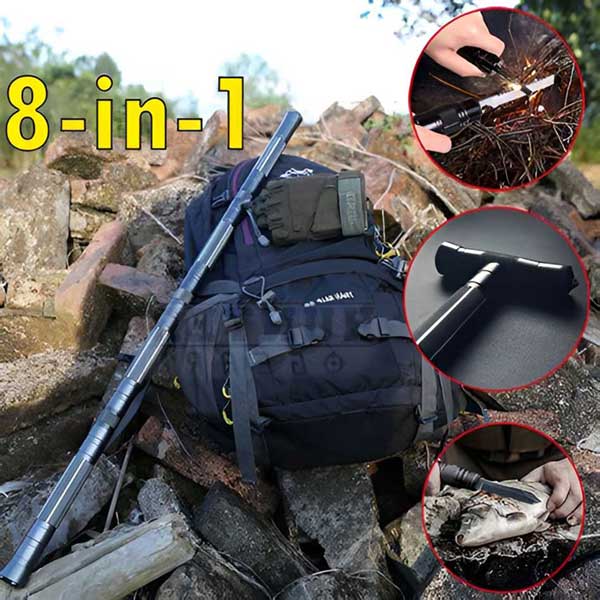
Our Outdoor Tactical Walking Stick is a sturdy metal stick with an anti-slip grip and tools stored inside the shaft.
Setting the height
Stand upright on level ground in the shoes you walk in. Hold the grip with the tip beside your foot. Your elbow should be bent at about a right angle, with your forearm level. If your shoulder rises as you plant the stick it is too long; if you lean forward to reach the ground it is too short.
Using it on the trail
- On the flat: plant the stick in step with the opposite foot, the way your arms swing naturally.
- Uphill: shorten your reach and plant the stick close to you, then push down on it as you step up.
- Downhill: plant the stick ahead of you before you step, so your arm takes some of the weight off your knees. Take shorter steps.
- Across a slope: hold the stick in the downhill hand.
- Crossing water: face slightly upstream, test the depth and the footing with the stick, and move one point of contact at a time.
- Mud, snow and long grass: probe before you step if you cannot see the ground.
Looking after it
- Dry the stick after wet walks, especially any threaded joints.
- Check that every section is tight before you set off.
- Replace a worn tip or rubber cap before it stops gripping.
Safety
A stick helps your balance; it does not replace good footwear or careful route choice. In a thunderstorm, get off high and open ground. If your stick carries tools or a blade, check local rules before carrying it in town, and pack it in checked baggage when you fly.